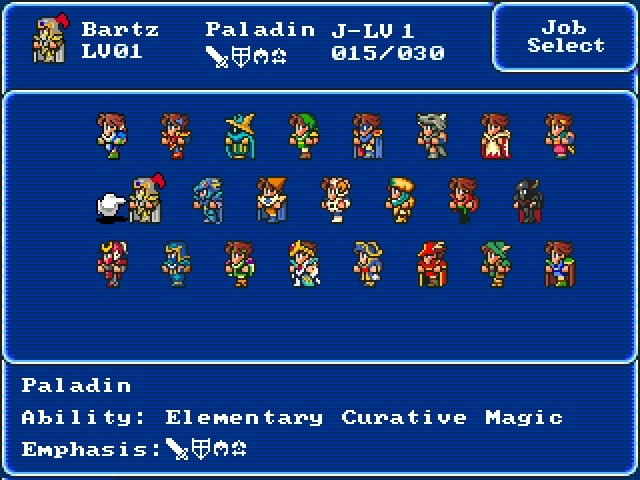
When I first started to play video games, there was one thing that I absolutely hated and it was making a choice that could restrict my character’s capabilities. That choosing one option would lead to the another one becoming inaccessible based on a single choice that I made. One of the most mechanically important decisions that one could make in RPGs is choosing a class.
Class types can be different among games, but I am mostly referring to the RPG context in which you either create a character in the very beginning and choose their class. A class system can also exist with non-created characters as there’s been several iterations such as the Asterisk system from Bravely Default in which you gain classes after fighting certain bosses that are either met through the story or through side quest.
Class systems are restricting because they define everything about your character’s abilities and overall vibe. If you pick a class such as a thief, then there is an immediate implication that your character is dexterous and stealthy. They’ll have an entirely different Kit than say a wizard in the same game which has the connotation of being proficiency in the arcane and can weave spells. Changing a class in many incurs a cost of time or resources. It is also usually a choice that cannot be made mid-battle.
Class systems are meant to fit your character in a box. In the past, I preferred systems like Skyrim where your character is capable of mastering every single system in the game. You are not forced to choose a set of skills that define you, but instead you can be good at everything.
Now my tastes have developed over the years and now I am completely against the “Jack of all trades, master of everything” system that exists in the modern Bethesda games because I found immense value in the class systems whenever you’re interfacing with an RPG.
One of the primary benefits of a class system in any RPG is that it allows the character that you created to better interface with the setting. If you’re playing a thief as mentioned prior, the game can react to your profession as a thief. Characters can call you a scoundrel, you can be presented with unique options to steal from NPCs, or even have a unique set of sidequests that are only available if you have a rougeish background.
This grants your character much more verisimilitude when compared to another character who holds mastery over everything. It rewards your choice at the very beginning and plays with the concept of the character that you created. Even something simple like the dialogue options in Baldur’s Gate III that label an option as [Bard] or [Fighter] is gratifying to see.
A secondary benefit of a class system is difficulty. Different missions and quest lines can be made more or less difficult depending on the classes that you pick. If you’re a fighter, you might have difficulty navigating a mystical forest with primordial animals. A druid may thrive in such an environment, but then the tables may turn when those same characters are placed in the middle of a gladiatorial arena. Now the fighter may have a chance to shine when faced with a battle that emphasizes close-quarters weapon fighting and the druid may lose their advantage of being in nature.
This is not to say that the experience should be dreadful or that characters should become useless the moment they step off familiar turf, but a wizard should find it easier to navigate an enchanted tower filled with magical traps and puzzles.
This is also connected to the third reason that class systems work. It is that in a cooperative session, different classes are allowed to shine and provide the players an opportunity to round out each other’s strengths and weaknesses. Playing Baldur’s Gate III with my friend and casting haste on him and then having him dunk on a boss with a bunch of weapon attacks was awesome. It presented the strengths of both of the characters that we made and provided a cool moment of synergy.
The most interesting is how class systems can be recontextualized depending on the setting or even genre. Fighters in a fantasy setting can be turned into soldiers or mercenaries. Giving them a unique flavor, but still keeping them within the same theme. Wizards in a cyberpunk setting may turn into hackers. A setting in which their vast intelligence is applied to technology rather than magic, yet both accomplish the goal of using intelligence to manipulate the world.
The only limitation that I could see is if there is a game series that has a limited number of classes that don’t account for the different aesthetics or playstyles that people wish to embody.
So what’s your go-to class in video games or TTRPGs? Is there any class that you feel is underrepresented in the RPG genre? A particular class that you don’t see much, but you wish you did?
I myself wish more games had a gunblade class like Final Fantasy XIV Gunbreaker class. To me, it’s a unique aesthetic in the tank class. I don’t think that every game should have a gunblade, but the use of magical technology is something that I find compelling in fantasy settings.
 Pendragon Press
Leave a comment